

Concessions, occupation and the invasion of Poland
1938–1939
Hitler annexed Austria and acquired Czechoslovakia’s borderlands. Continued German expansion undermined the hope that concessions would contain it. The invasion of Poland in September 1939 brought Britain and France into the war; the Soviet Union then invaded Poland from the east.
In March 1938, Hitler annexed Austria to Germany. He then demanded the Sudetenland, Czechoslovakia’s borderlands with their large German-speaking population. Czechoslovak president Edvard Beneš also feared losing the country’s ability to defend itself. The dispute concerned the security of the whole state, not simply moving a line on a map.
British prime minister Neville Chamberlain tried to avert war through concessions. Appeasement drew partly on fear of repeating the losses of the First World War and the cost of another conflict. Those concessions accepted Nazi demands at the expense of a country whose future other powers were deciding.
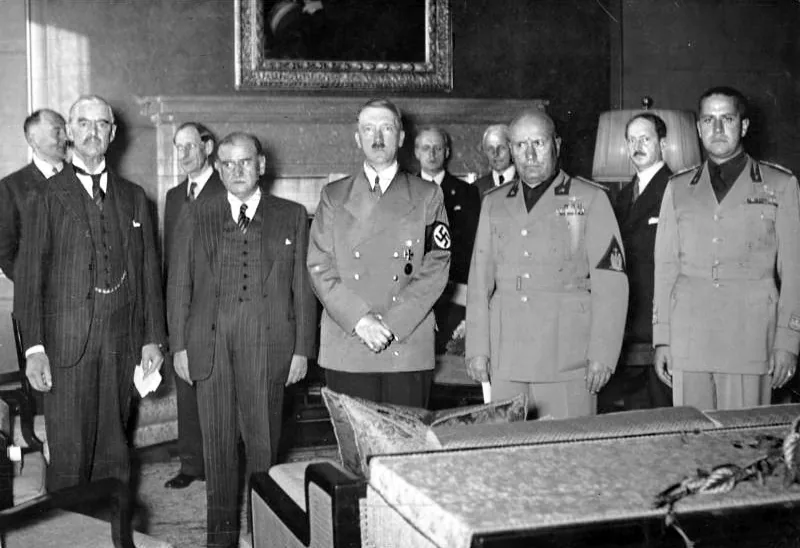
At Munich, Germany, Britain, France and Italy agreed to transfer the borderlands to Germany. The agreement, dated 29 September, specified evacuation and German occupation in stages from 1 to 10 October. Czechoslovakia’s government accepted it on 30 September. Chamberlain regarded the settlement as a way to preserve peace; subsequent events overturned that expectation.
Sources, licences and acknowledgements
Bundesarchiv, Bild 183-R69173 / CC-BY-SA 3.0 · Original · CC BY-SA 3.0 DE

Wikimedia Commons version: lossless crop, tonal adjustment and repairs by DIREKTOR in 2015. Chrona provides resized and compressed WebP variants without further cropping. Derivative images retain CC BY-SA 3.0 DE.
On 15 March 1939, German forces occupied Prague. A German protectorate was established over Bohemia and Moravia, while Slovakia had a different state arrangement. Taking territory with German-speaking inhabitants had not been the final goal of Hitler’s expansion. Czechoslovakia no longer functioned in its previous form.
Hitler and Stalin then changed the balance in eastern Europe through an agreement between their states. The Nazi–Soviet pact of 23 August 1939 combined a public promise of non-aggression with secret spheres of influence, including Poland. Two regimes hostile in ideology agreed not to attack one another and to determine the fate of neighbours.
The German Army invaded Poland on 1 September. Britain and France declared war on Germany on 3 September; Soviet forces invaded Poland from the east on 17 September. War in China was already underway, but the European great-power conflict conventionally associated with the beginning of the Second World War had now started.
Poland’s defeat was followed by occupation. Germany annexed part of the country and administered another part as the General Government. The occupiers killed political, intellectual and religious leaders, displaced people and used them for forced labour. From the outset, military conquest therefore belongs alongside the history of occupation and resistance.
Places
- Munich: Czechoslovakia’s borderlands are ceded
The agreement transferring Czechoslovakia’s borderlands.
- Prague: the occupation begins
German occupation of the city in March 1939.
- Poland: invasion, partition and the beginning of occupation
German and Soviet invasions and the beginnings of occupation.
In 1940, German attacks spread into northern and western Europe.