

China and Japan’s pursuit of empire
1931–1938
East Asia’s war did not begin at Pearl Harbor. Japan’s seizure of territory in China developed into full-scale war in 1937. Chinese resistance continued after major cities fell, while occupation brought violence and displacement to their inhabitants.
Japan sought predominance in Asia. Its army extended control over Chinese territory; this expansion had its own development and aims, rather than being a sideshow to a European war. Japan’s imperial expansion combined military conquest with a claim to direct the political and economic life of conquered countries.
On 18 September 1931, an explosion damaged railway track near Mukden, now Shenyang. Japanese forces used the incident to invade Manchuria. Manchukuo was subsequently proclaimed: a nominally autonomous state controlled by the local Japanese Army. A dependent state could give military domination the outward form of separate institutions.
China appealed to the League of Nations. In 1933, the League endorsed a report rejecting recognition of Manchukuo as a violation of China’s territorial integrity. The decision did not end Japanese control. Collective security confronted the gap between diplomatic condemnation and the ability to restore conquered territory.
China’s politics were divided. Nationalists led by Chiang Kai-shek were rivals of the Communists; after the crisis of 1936, the two sides agreed a ceasefire to oppose Japan. A common enemy brought former opponents into cooperation. Chinese resistance nevertheless cannot be reduced to one army or one leader.
The clash between Chinese and Japanese forces at the Marco Polo Bridge on 7 July 1937 escalated into full-scale war. Chiang committed his best troops to defend Shanghai, which fell after three months of fighting. Japanese forces advanced to the capital, Nanjing, and occupied it on 13 December. China’s government moved inland to Chongqing and kept fighting: losing the capital did not mean the country had surrendered.
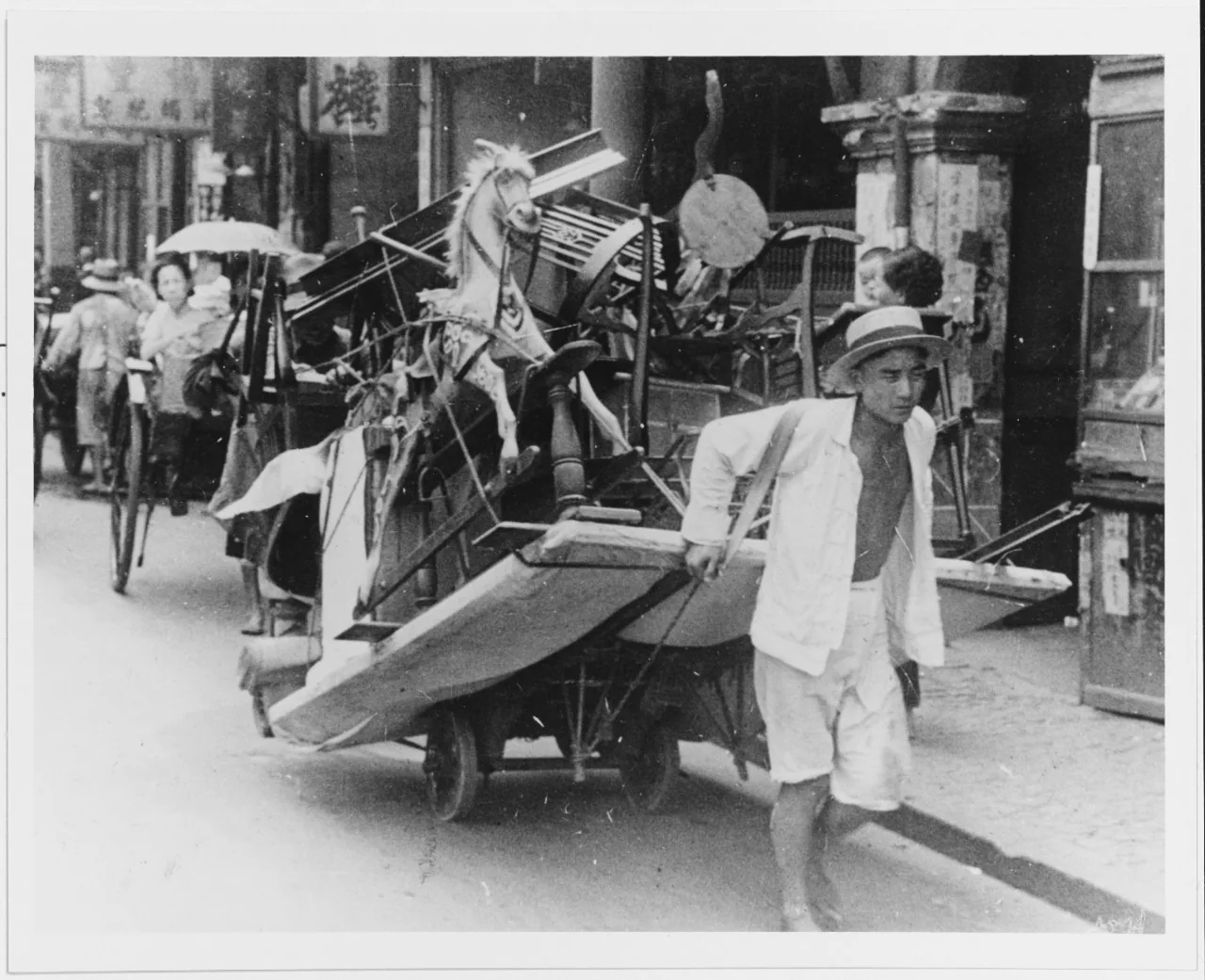
Sources, licences and acknowledgements
Naval History and Heritage Command, NH 77756; courtesy of Vice Admiral Morton L. Deyo, USN (retired) · Original · Public domain — US Navy work (Commons PD-USNavy)

The Wikimedia Commons original is retained. Chrona provides resized and compressed WebP variants without further cropping.
In Nanjing, Japanese troops killed civilians and committed sexual violence. American diplomatic reports from January 1938 record authenticated accounts of killings and continuing rape in the refugee zone. People feared going home; some who returned were robbed, raped or killed. The capture of the city was also a catastrophe for its inhabitants.
The war continued beyond the cities that had fallen. Japanese aircraft bombed inland cities in an effort to break Chinese morale, but China remained at war. This prolonged, unresolved conflict would become important to Japan’s further expansion and its confrontation with the United States.
Places
- Mukden: from railway explosion to occupied Manchuria
The incident followed by the Japanese invasion of Manchuria.
- Marco Polo Bridge: a clash becomes full-scale war
The July 1937 clash and the expansion of the war.
- Nanjing: conquest, mass violence and attempts to protect civilians
Occupation, violence against civilians and refugee relief.
Meanwhile, concessions in Europe had not stopped Hitler’s expansion.