

Adolf Hitler
Nazi leader: ideology, power and aggressive war
1889–1945
Adolf Hitler led the Nazi Party and became head of Germany’s government in 1933. He transformed that position into a dictatorship that suppressed opponents, persecuted Jews and waged aggressive war. His vision of racial domination linked the regime’s domestic policies to territorial conquest. He killed himself on 30 April 1945 as Nazi Germany collapsed.
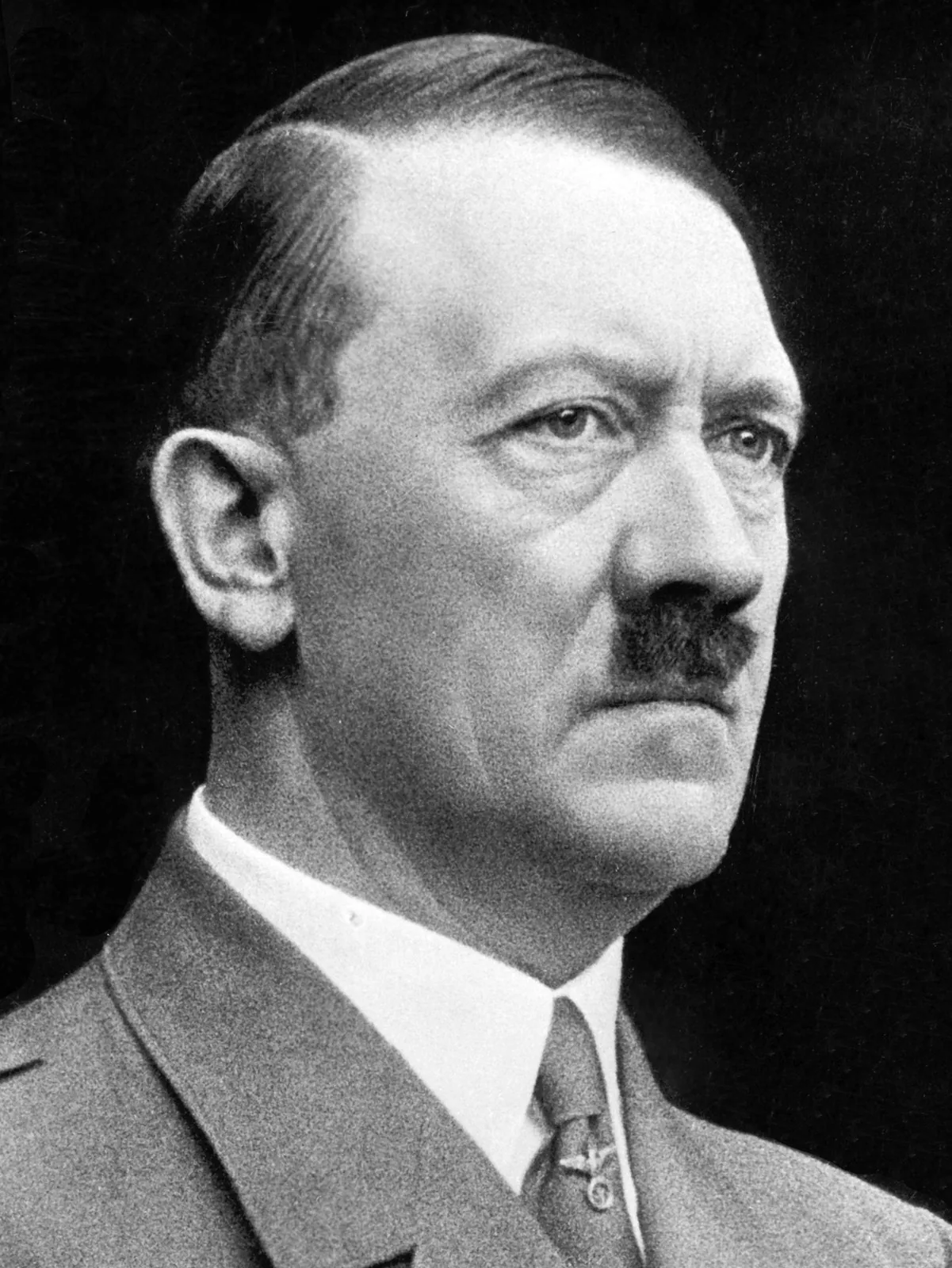
Sources, licences and acknowledgements
Bundesarchiv, Bild 183-S33882 / CC BY-SA 3.0 DE · restaurování / restoration: AM · ořez / crop: Wabbuh · Original · CC BY-SA 3.0 DE

The Commons version is cropped and retouched. Chrona resizes and compresses it; derivatives retain CC BY-SA 3.0 DE.
From war to political movement
Hitler was born in 1889 in what was then Austria-Hungary. He served in the German Army during the First World War. In 1919 he joined the German Workers’ Party, the predecessor of the Nazi Party, which he led from 1921.
His speeches attacked the Treaty of Versailles, communism and Jews. He promised renewed national strength and identified supposed enemies to blame for society’s problems. Nazi antisemitism was not an incidental part of the programme: it shaped the vision of who belonged to the nation and who was to be excluded.
Failed coup and the route into government
His attempt to take power in a Munich coup in 1923 failed, and he went to prison. There he dictated much of the first volume of Mein Kampf, setting out plans for territorial expansion and racial dictatorship.
The economic depression after 1929 gave the Nazis an opportunity to win more voters with promises of jobs and recovery. Propaganda and street violence accompanied that support. After the November 1932 election, they held the most parliamentary seats but not a majority. Conservative politicians persuaded President Hindenburg to appoint Hitler chancellor of a coalition government on 30 January 1933.
From chancellor to dictator
After the Reichstag fire, emergency powers enabled the imprisonment of opponents. The March 1933 Enabling Act allowed the government to legislate without parliament. Trade unions were forcibly dissolved, and the Nazis became the only legal party. After Hindenburg’s death in 1934, Hitler combined presidential and chancellor powers.
The Nazi regime controlled the state by suppressing independent political competition and expanding police powers. For those persecuted, concentrated power meant imprisonment and the loss of employment, property and rights. The 1935 Nuremberg Laws embedded racial exclusion in state law.
Racial policy and conquest
Hitler wanted “living space” in the east, to be acquired through conquest and Germanisation. Rearmament and violations of Versailles were followed by Austria’s annexation, the acquisition of Czechoslovak borderlands and the occupation of Prague. Germany’s invasion of Poland in September 1939 brought Britain and France into the war.
Germany invaded the Soviet Union in June 1941. The invasion’s objectives included destroying Soviet power, controlling resources and dispossessing inhabitants for German settlement. The regime Hitler led murdered approximately six million Jews in the Holocaust. His rule cannot be divided into a military career and an unimportant side story of persecution.
Defeat and death
Nazi Germany could not turn its early conquests into final victory. Allied armies advanced into the country from east and west. Hitler killed himself on 30 April 1945; Soviet forces captured Berlin in the final phase, and Germany’s military surrender followed in May. The dictator’s death did not remove the consequences of his rule or the responsibility of other perpetrators.
Explore further
- Nazi dictatorship
How the regime used political and police power.
- The Holocaust
The genocide perpetrated by the regime he led.
- Berlin at the war’s end
The place of his death and the collapse of Nazi power.