

Chrona

The interactive map is loading…

Two fronts converge on Germany

1943–May 1945

Soviet armies gained the initiative in the east, while the Western Allies opened fronts in Italy and France. Their advances brought down Nazi power, but liberation unfolded differently in particular places. Germany’s military surrender came in May 1945.

Stalingrad did not decide the eastern war by itself. Germany attacked again near Kursk in July 1943, but Soviet victory helped transfer the initiative to the Red Army. In June 1944, a Soviet offensive in Belarus nearly destroyed German Army Group Centre. These campaigns bridge the gap between Stalingrad and Berlin’s fall: German armies were being driven progressively west.
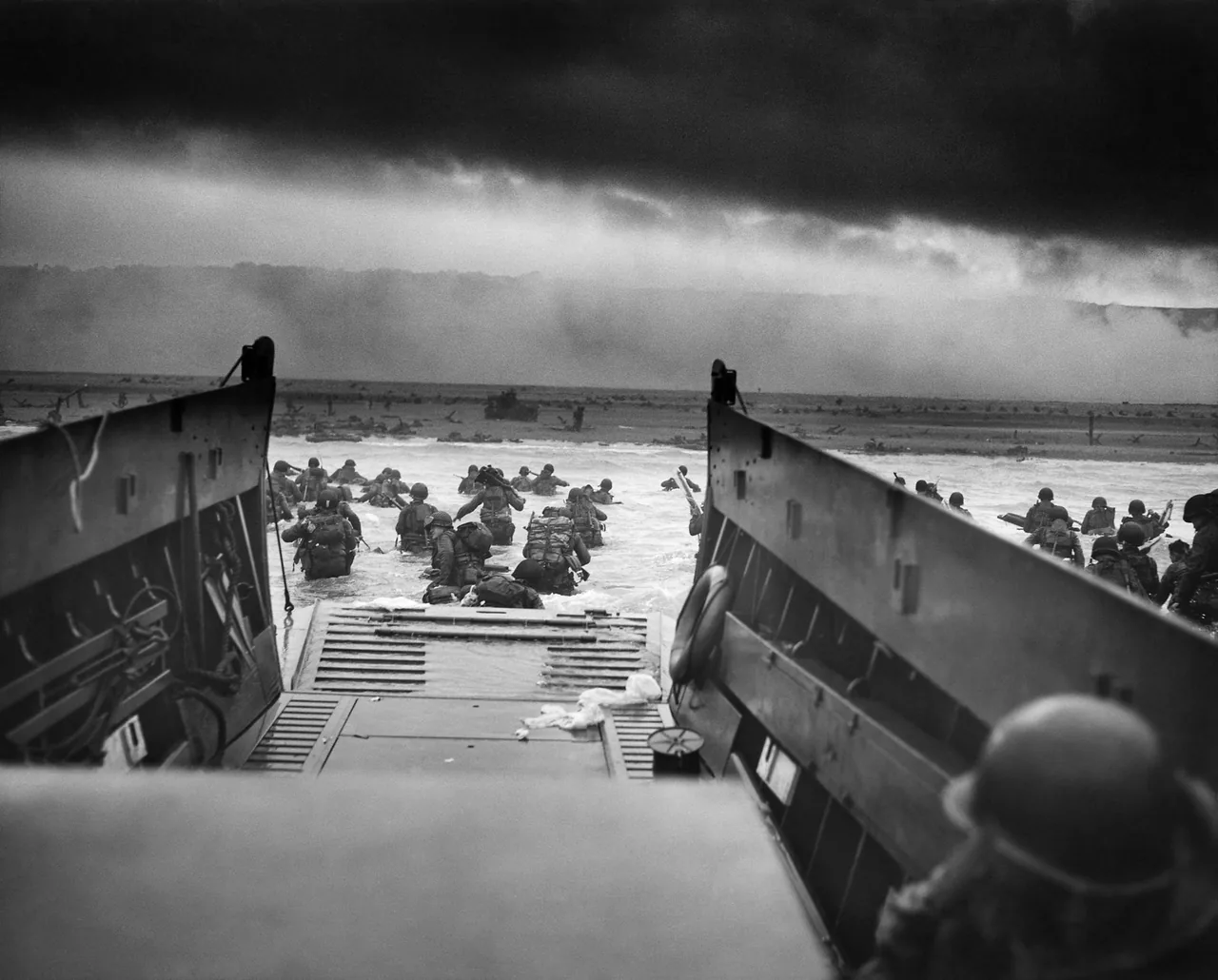
Soldiers wade towards the shore from the open ramp of a landing craft.
US troops leave a landing craft at Omaha Beach, 6 June 1944.
Sources, licences and acknowledgements

Robert F. Sargent / U.S. Coast Guard · NARA 195515 · Original · Public domain (US government work)

Commons restoration (crop, contrast and dust removal), resized and compressed by Chrona.

The Western Allies invaded Sicily and then mainland Italy in 1943. On 6 June 1944, they landed in Normandy under supreme commander Dwight Eisenhower. The operation opened a major front in France. Germany now faced Soviet armies advancing from the east and the Western Allies through France.

The advance was not everywhere quick or straightforward. Late in 1944, Germany attempted to reverse its position with a counter-offensive in the Ardennes, but failed. In January 1945, the Red Army advanced from Poland towards the Oder; in March, the Western Allies crossed the Rhine. The area under German control was contracting from both sides.

Allied armies also liberated camps. Soviet troops entered Auschwitz on 27 January 1945. Liberation ended the perpetrators’ control, but many prisoners had already been forced to march elsewhere. Military advances and survivors’ experiences intersected without reaching the same ending.

In the final phase, Soviet forces captured Berlin. Hitler killed himself on 30 April 1945. His death did not itself end the fighting or constitute the surrender of all German forces. The dictatorship’s end unfolded on military, political and local levels.

In Prague, an uprising began on 5 May. Part of the Russian Liberation Army, which had previously fought on Germany’s side, also assisted the insurgents. A ceasefire on 8 May allowed German withdrawal, but some units did not obey it. Soviet troops entered on 9 May. Local resistance, negotiations and an army’s arrival contributed differently to the occupation’s end.

Germany’s military surrender was signed at Reims on 7 May and ordered active operations to cease at 23:01 Central European Time on 8 May. At Soviet insistence, a further signing took place in Berlin on 8 May. This sequence explains the May victory commemorations, while a document’s signature and the end of a particular local battle did not necessarily coincide.

Places

Germany’s defeat ended the war in Europe. Fighting continued in Asia and the Pacific.

Sources

  • The Holocaust, part two · The National Archives; background by Dan Stone

    Explanation of Auschwitz I/Birkenau; general background repeated from part one.

    Contains public sector information licensed under the Open Government Licence v3.0: https://www.nationalarchives.gov.uk/doc/open-government-licence/version/3/ . This use covers selected explanatory text, not archival photographs or other separately credited objects.

  • The Liberation of the Death and Concentration Camps, Europe, June 1944–May 1945 · UK Ministry of Defence / COI, 2005

    Printed pages 6–9 (PDF 8–11). Surrounding estimates, inaccurate generalisations and third-party quotations are excluded.

    Contains public sector information licensed under the Open Government Licence v3.0: https://www.nationalarchives.gov.uk/doc/open-government-licence/version/3/ . Selected Crown text only; separately credited photographs, maps, poetry and testimony are excluded.

  • 1942 + 80 Years – Operation Uranus: Turning the Tide in Europe · Nicholas J. Dilley · Ronald Reagan Presidential Library · National Archives

    Main battle paragraph on city, encirclement and surrender; surrounding estimates and generalisations excluded.

    Original US federal institutional explanation; separately credited imagery and original films are not reused.

  • General Eisenhower’s Order of the Day (1944) · National Archives

    Preparation, Eisenhower’s failure message and the June 1944 operation; no borrowed speeches or precise troop totals.

    Selected original US federal institutional text. Photographs, third-party quotations and reader comments are excluded.

  • Special Display of V-E Document and Maps for Press Only · National Archives, 2005

    Selected D-Day date and Hitler death clause; rhetorical/superlative and broader political assertions excluded.

    Selected original US federal institutional text. Photographs, third-party quotations and reader comments are excluded.

  • Surrender of Germany (1945) · National Archives

    Institutional signing explanation and official Act of Military Surrender; distinguishes military orders from local fulfilment.

    Selected original US federal institutional text. Photographs, third-party quotations and reader comments are excluded.

  • The Potsdam Conference, 1945 · US Department of State, Office of the Historian

    Conference dates, leadership, four occupation zones, agreed measures and already occurring population transfers.

    Selected original US federal institutional text. Photographs, third-party quotations and reader comments are excluded.

  • Prague uprising · Wikipedia contributors

    Introduction and explanation of partial Russian Liberation Army assistance; no casualty totals or exact sites inferred.

    Source text: CC BY-SA 4.0, https://creativecommons.org/licenses/by-sa/4.0/ . Chrona uses original wording, not a hosted article, quotation or photograph. History and contributors are available at the source.

  • World War II · Wikipedia contributors

    Specific paragraphs of the retained article revision; exact claim evidence is retained separately.

    Source text: Wikipedia contributors, CC BY-SA 4.0, https://creativecommons.org/licenses/by-sa/4.0/ . History and contributors are available at the original article. Chrona uses original wording; photographs and the complete article are not reproduced here.

  • Dwight D. Eisenhower · Wikipedia contributors

    Specific paragraphs of the retained article revision; exact claim evidence is retained separately.

    Source text: Wikipedia contributors, CC BY-SA 4.0, https://creativecommons.org/licenses/by-sa/4.0/ . History and contributors are available at the original article. Chrona uses original wording; photographs and the complete article are not reproduced here.