

Normandy: landings, a foothold and the advance into France
Story period: June–August 1944
Location: Normandy coast, France
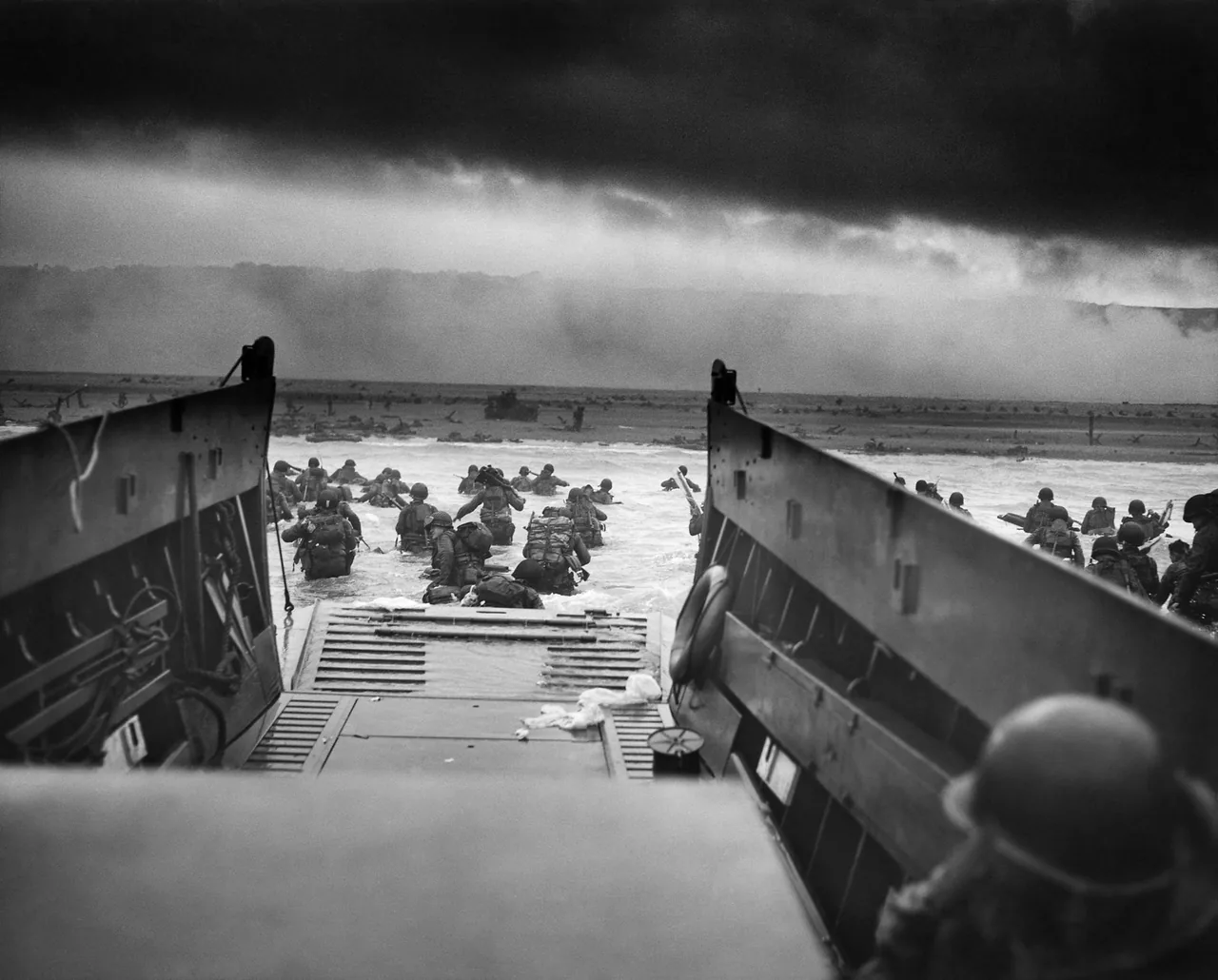
The Allied landings in Normandy on 6 June 1944 established a foothold in northern France. A difficult campaign followed before Allied forces broke through and advanced towards Paris. Normandy opened a new route against Germany from the west while the Soviet Union continued fighting on the eastern front.
Sources, licences and acknowledgements
Robert F. Sargent / U.S. Coast Guard · NARA 195515 · Original · Public domain (US government work)

Commons restoration (crop, contrast and dust removal), resized and compressed by Chrona.
Preparing a new front
1943–June 1944
Putting an army ashore required preparation and a decision under uncertainty.
Roosevelt and Churchill reaffirmed the cross-Channel plan in 1943. Troops, ships and aircraft were concentrated in Britain. The timing depended on weather and suitable tidal conditions, not simply on choosing a date in a calendar.
Before dawn on 5 June, Eisenhower decided to proceed. His prepared message accepting responsibility if the operation failed records the uncertainty before success was known.
D-Day was a beginning, not the whole campaign
June–August 1944
A landing had to become a sustained advance.
The landings took place on 6 June. Creating a foothold did not immediately defeat the German forces in France. The Allies broke the German lines in the summer and advanced towards and around Paris, liberated in August.
That sequence explains why the place story covers a campaign rather than treating everything as an event that ended on D-Day. The military value of reaching the coast depended on what forces could do after landing.
Germany faced pressure from more than one direction
1944
Western and Soviet operations belonged to the same wider defeat.
In June 1944 the Soviet Union also launched a major offensive in Belarus, nearly destroying German Army Group Centre. The Allied strategy account connects cooperation with disputes about timing and priorities.
The Western Allies advanced from France; Soviet forces later captured Berlin. Normandy was a crucial part of Germany’s defeat, not a substitute for explaining the eastern front.
A regional reference point helps locate the wider area. It does not mark an individual landing beach; present administrative boundaries are not the operation’s boundary.
Explore further
- Paris: liberation
Allied forces broke through after Normandy and advanced towards Paris.