

Why the balance of the war changed
1942–1943
Neither Japan nor Germany could turn its early conquests into final victory. Midway, North Africa and Stalingrad brought different military reversals. A prolonged war also increased the importance of production, supplies and the Allies’ ability to combine their strengths.
By early 1942, the Axis had made extensive conquests. By the end of April, Japan and its Thai ally had taken Malaya, Singapore, the Dutch East Indies and most of Burma, among other territories. Germany still held much of the Soviet territory it had conquered. Yet the war was no longer a sequence of rapid, decisive victories: China, the Soviet Union and Britain were still fighting.
Sources, licences and acknowledgements
Geoffrey Keating / No. 1 Army Film and Photographic Unit · Imperial War Museums, E 6600 · Original · Public domain (expired Crown copyright)

Archival digital photograph resized and compressed without additional cropping.
At Midway in June 1942, Japan lost four aircraft carriers. American codebreakers had deciphered messages revealing the likely place and time of attack. Losing the carriers reduced Japan’s ability to conduct further offensives. American landings on Guadalcanal in August opened a campaign lasting roughly six months: a naval reversal had to be followed by a prolonged struggle for territory.
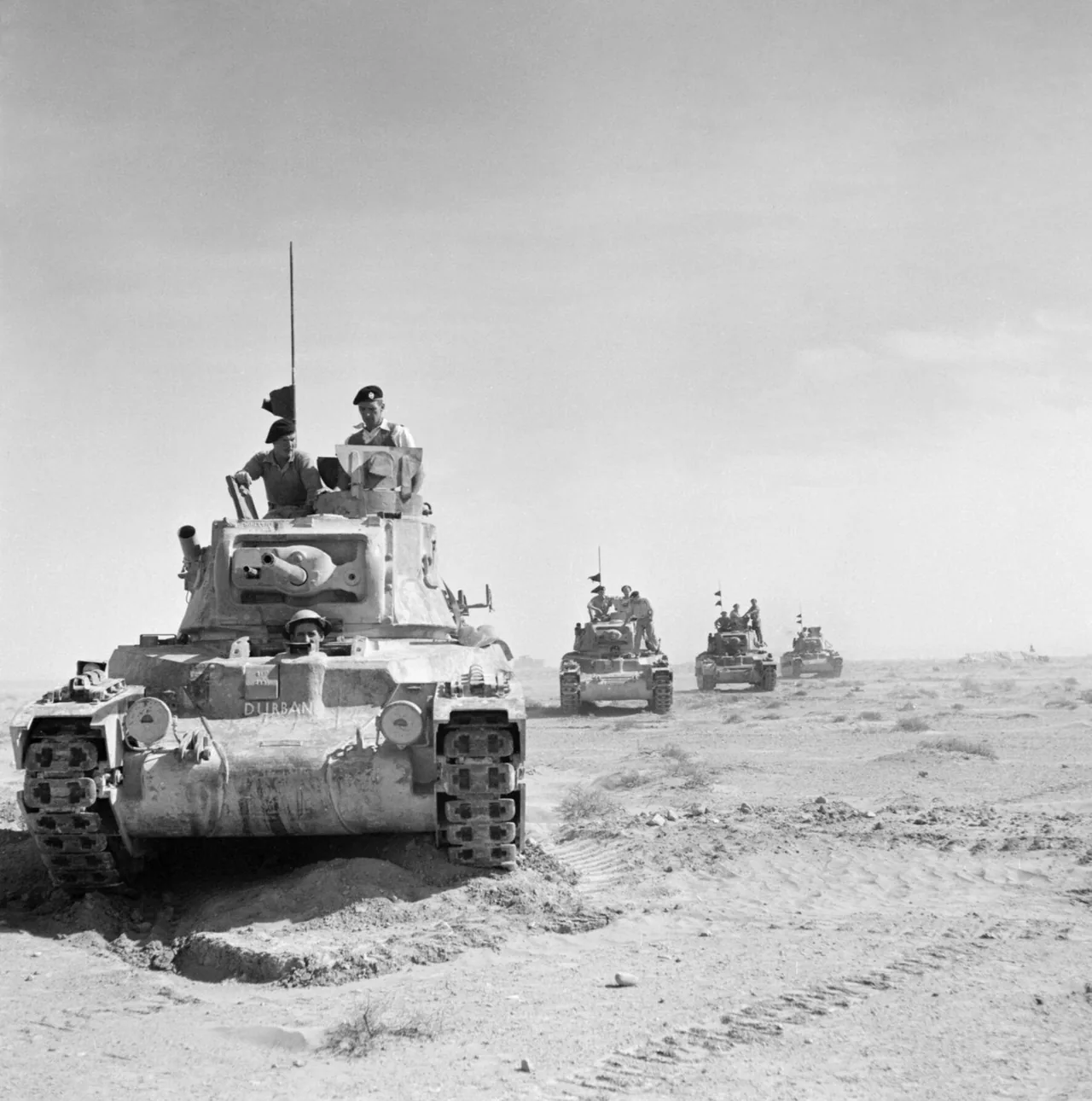
In North Africa, German and Italian advances threatened the Allied position in Egypt. Victory at El Alamein, between 23 October and 4 November 1942, shifted the desert campaign in the Allies’ favour and helped protect vital supply routes. This was not solely a British achievement: troops from India and other parts of the British Empire also made important contributions.
In November, British and American forces landed in French North Africa. Axis forces withdrew into Tunisia, which the Allies conquered in May 1943. Victory in North Africa therefore combined the advance from Egypt with new landings in the west, rather than resulting from one battle alone.
Germany’s summer 1942 offensive headed into the southern Soviet Union towards the Caucasian oilfields and the Volga. At Stalingrad, devastating bombing was followed by street fighting. A Soviet counter-offensive in November encircled the German Sixth Army. Supplies could not sustain the trapped forces, whose resistance ended in surrender in early February 1943. An advance of conquest had become an enormous German defeat.
These Axis reversals took place in a longer war in which Allied advantages in population and economic resources carried increasing weight. Ships, aircraft, fuel and trucks had to be produced and delivered to the fighting fronts. War supplies and the contribution of empires therefore belong in the explanation alongside commanders and battles.
Allied leaders had to negotiate how to use these strengths. At Casablanca in January 1943, Roosevelt and Churchill planned further Mediterranean operations, aid to the Soviet Union, preparations for landings in France, operations against Japan and supplies to China. They announced a demand for unconditional surrender. Defeating the Axis was a shared goal, but getting there required choices between distant fronts.
Places
- Midway: a Japanese offensive meets prepared defenders
Naval warfare and intelligence.
- El Alamein: turning the North African campaign
Supply routes and imperial forces.
- Stalingrad: a devastated city and an encircled army
Encirclement and the attackers’ defeat.
Stopping the invaders was not the same as defeating them. The next chapter follows the Allied armies towards Germany.