

How democracy became dictatorship
1919–1938
Nazism promised renewed German power while promoting racism, hatred of Jews and the destruction of democracy. Economic crisis helped Hitler gain support; after his appointment to government came the suppression of opposition and preparations for expansion.
After the First World War, Germany was a parliamentary republic. The Treaty of Versailles restricted its armed forces and took away territory. Adolf Hitler attacked these terms as a humiliation and promised to overturn them. Discontent did not dictate a single future: the Nazis still had to win support and gain access to power.
Hitler had led the Nazi Party since 1921. Its message combined extreme nationalism, anti-communism and antisemitism—hatred and prejudice against Jews. The Nazis made Jews into an enemy of society. Hitler also demanded “living space” in the east: territory for Germany to conquer and Germanise. Racial ideology was therefore bound to his vision of aggressive expansion.
The world economic depression brought mass unemployment. The Nazis promised jobs, economic recovery and renewed national strength. Propaganda went alongside intimidation of opponents by armed party groups. The party became the largest in parliament, but after the November 1932 election it still lacked a majority.
President Hindenburg appointed Hitler chancellor on 30 January 1933 after conservative politicians, including Franz von Papen, persuaded him to do so. Hitler was not directly elected to unlimited power. He entered a coalition government and then used state authority against his opponents.
After the February Reichstag fire, emergency powers enabled the imprisonment of political opponents. The March Enabling Act allowed the government to make laws without parliament. Trade unions were forcibly dissolved, and in July 1933 the Nazi Party became the only legal party. After Hindenburg’s death in 1934, Hitler merged the presidency and chancellorship. These steps removed ways to check or peacefully replace the government.
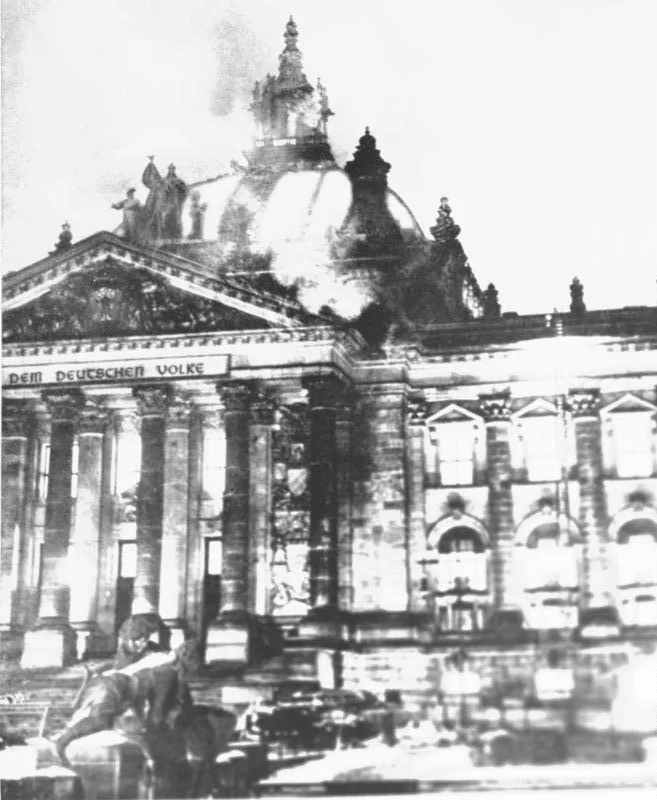
Sources, licences and acknowledgements
Bundesarchiv, Bild 183-R99859 / Unknown Unknown / CC-BY-SA 3.0 · Original · CC BY-SA 3.0 DE

Wikimedia Commons version: Wvdp removed the border with a lossless horizontal crop (4%) in 2021. Chrona provides resized and compressed WebP variants without further cropping. Derivative images retain CC BY-SA 3.0 DE.
The dictatorship was already changing lives before the war. The Nazis organised a boycott of Jewish shops and excluded Jews from government employment. The Nuremberg Laws, announced in Nuremberg in 1935, deprived German Jews of citizenship rights and prohibited marriages between Jews and other Germans. The November 1938 pogrom brought the destruction of synagogues and shops. Persecution operated through both state policy and open violence.
At the same time, Hitler restored conscription and sent troops into the demilitarised Rhineland in 1936. Germany was overturning postwar military restrictions. Britain and France feared another devastating war; concessions known as appeasement were intended to prevent one. Hitler’s further expansion showed that his aims went beyond removing the restrictions of Versailles.
Places
- Nuremberg: racial exclusion becomes law
The announcement of racial laws at the party rally.
Meanwhile, a different road to war was opening in East Asia.