

Victory and the difficult beginning of peace
1945–1948
Victory ended Nazi domination and defeated Japan’s empire, but survivors still needed homes, care and justice. The Allies built postwar institutions while increasingly disagreeing over territory, security and political power.
Release from a camp or the end of occupation did not automatically mean going home. Earl Harrison’s report, received by the American president in August 1945, described inadequate housing and medical care for Jewish survivors in Germany. People persecuted by the Nazis also needed opportunities to decide their future. Reconstruction began with concrete needs, not just diplomatic negotiations.
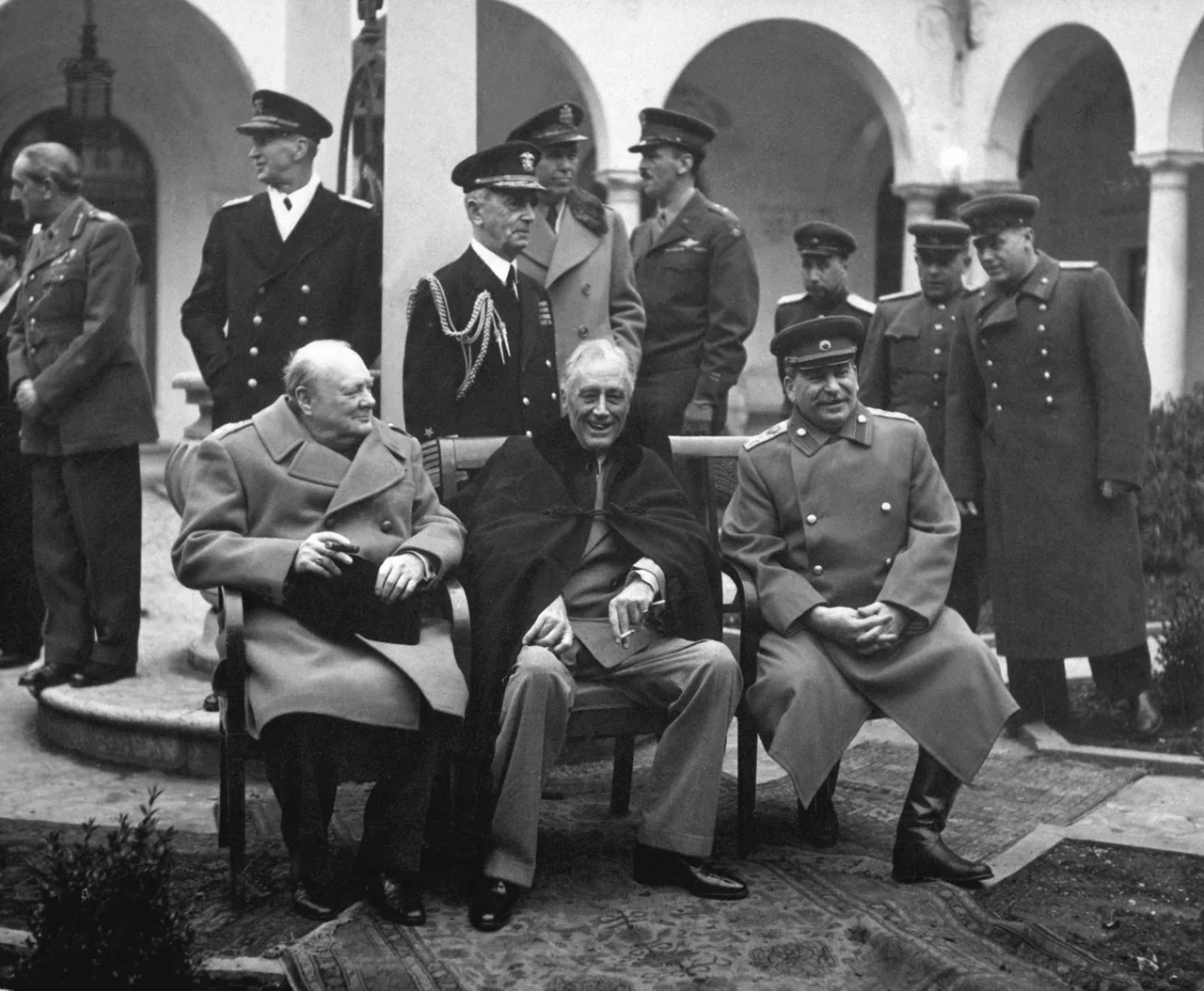
Sources, licences and acknowledgements
U.S. government photographer · NARA, 111-SC-260486 · Original · Public domain (US government work)

Archival digital photograph resized and compressed without additional cropping.
At Potsdam, from 17 July to 2 August, Stalin and Truman met British prime minister Churchill, who was replaced during the conference by Attlee. They confirmed Germany’s four occupation zones, disarmament and the removal of Nazi institutions. The former conqueror now came under the victors’ administration. Those victors disagreed over reparations and Europe’s future order.
War and postwar decisions displaced millions of people. Deportations of German populations were already underway; the powers called for transfers to be orderly and humane and asked Poland, Czechoslovakia and Hungary to suspend them temporarily. A diplomatic demand did not itself ensure the safety of those being moved. Decisions about borders had immediate consequences for inhabitants.
Postwar justice sought to define and punish crimes. Nazi leaders before the International Military Tribunal at Nuremberg faced charges of crimes against peace, war crimes and crimes against humanity. The Genocide Convention was adopted in 1948. Defeating armies was accompanied by attempts to establish responsibility for the actions of states and their leaders.
The United Nations came into existence on 24 October 1945. Its General Assembly and Security Council were intended to help preserve peace, but the Council’s permanent members held veto rights. The new organisation continued the effort at collective security in which the prewar League of Nations had failed. The involvement of great powers was meant to be a strength, while their disputes also constrained joint action.
Relations between former allies deteriorated. In March 1947, Truman asked Congress for aid to Greece and Turkey, presenting it as support for free peoples against pressure. His doctrine expressed a new direction in American foreign policy amid conflict with the Soviet Union. In Asia, after Japanese rule ended, the Soviet Union occupied northern Korea and the United States the south. Ending the war had not ended great-power conflict.
We began with dictatorship and expansion in Europe and Asia. Conquests connected the war in China, European battlefields and the Pacific; occupation and genocide transformed civilian lives. Allied armies, resources and resistance eventually brought the defeat of Germany and Japan. The postwar world inherited the dead, devastated places, displaced people and new disputes. The map and profiles return us to particular lives—or the more detailed Anthropoid journey shows how world history passed through individual households.
Places
- Potsdam: negotiating occupation and an unsettled peace
Negotiating the postwar world.
The war’s narrative ends here; its human consequences continue through particular places and lives.