

The bend below Vychovatelna — the attack on Heydrich
Story period: 27 May 1942
Location: the historical bend near Vychovatelna, Libeň
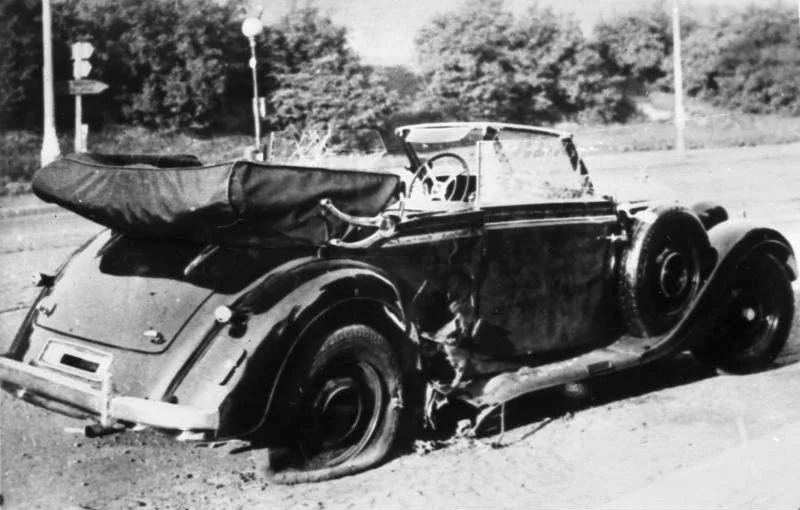
On 27 May 1942, this was where a clandestine operation became an open attack. The location was chosen because Heydrich’s car had to slow down at the sharp bend. When Gabčík’s submachine gun failed, Kubiš used the bomb they had prepared.
Sources, licences and acknowledgements
Bundesarchiv, Bild 146-1972-039-44 · photographer unknown · Original · CC BY-SA 3.0 DE

Uses the Commons version with earlier cropping and contrast adjustment; Chrona variants are resized and compressed. Derived images retain CC BY-SA 3.0 DE.
Why this bend?
spring 1942
Reconnaissance identified a place where the car coming from Panenské Břežany slowed down.
The parachutists considered several ways to carry out their mission. They identified a bend on the route to Prague Castle where the fast-moving car would be at a disadvantage.
Before the attack, the domestic resistance warned of far-reaching consequences. That warning is a distinct part of the story; it does not alter the existence of the military order or the decision to proceed.
The gun failed; the bomb exploded
27 May 1942, shortly after 10:30 a.m.
Gabčík did not fire; Kubiš struck the car with a bomb.
As the car driven by Johannes Klein slowed down, Jozef Gabčík’s STEN submachine gun jammed. Jan Kubiš threw a modified bomb. It exploded beside the car’s right rear section and wounded Heydrich.
The attackers escaped separately. Gabčík shot and wounded Klein as the driver pursued him. Kubiš, whose head had been injured by a fragment of the car body, sought help from resistance doctor Břetislav Lyčka. The medical account places Lyčka’s treatment of Kubiš at Jaroslav Piskáček’s apartment in Vysočany.
From Bulovka to renewed martial law
27 May–4 June 1942
Heydrich was taken to hospital as the occupying authorities immediately unleashed terror.
The wounded Heydrich was taken to nearby Bulovka Hospital. While he received treatment, German authorities sealed off Prague, began house searches and executions, and extended the state of emergency throughout the Protectorate.
Heydrich died on 4 June. Repression had begun before his death and often struck people with no direct connection to the operation.
The marker is a reference point for the historical bend. It does not establish the precise position of the car or individual participants.
Explore further
- Bulovka
Heydrich’s treatment after the attack
- The church in Resslova Street
a later refuge for Kubiš and Gabčík
- The Piskáček home
Kubiš’s refuge and treatment after the attack
Sources
- Atentát: Operace Anthropoid 1941–1942 · 58
- Atentát: Operace Anthropoid 1941–1942 · 64
- Atentát: Operace Anthropoid 1941–1942 · 64
- Atentát: Operace Anthropoid 1941–1942 · 64
- Atentát: Operace Anthropoid 1941–1942 · 64