

London: air defence and life through the Blitz
Story period: 1940–1941
Location: London and southeastern England, Britain
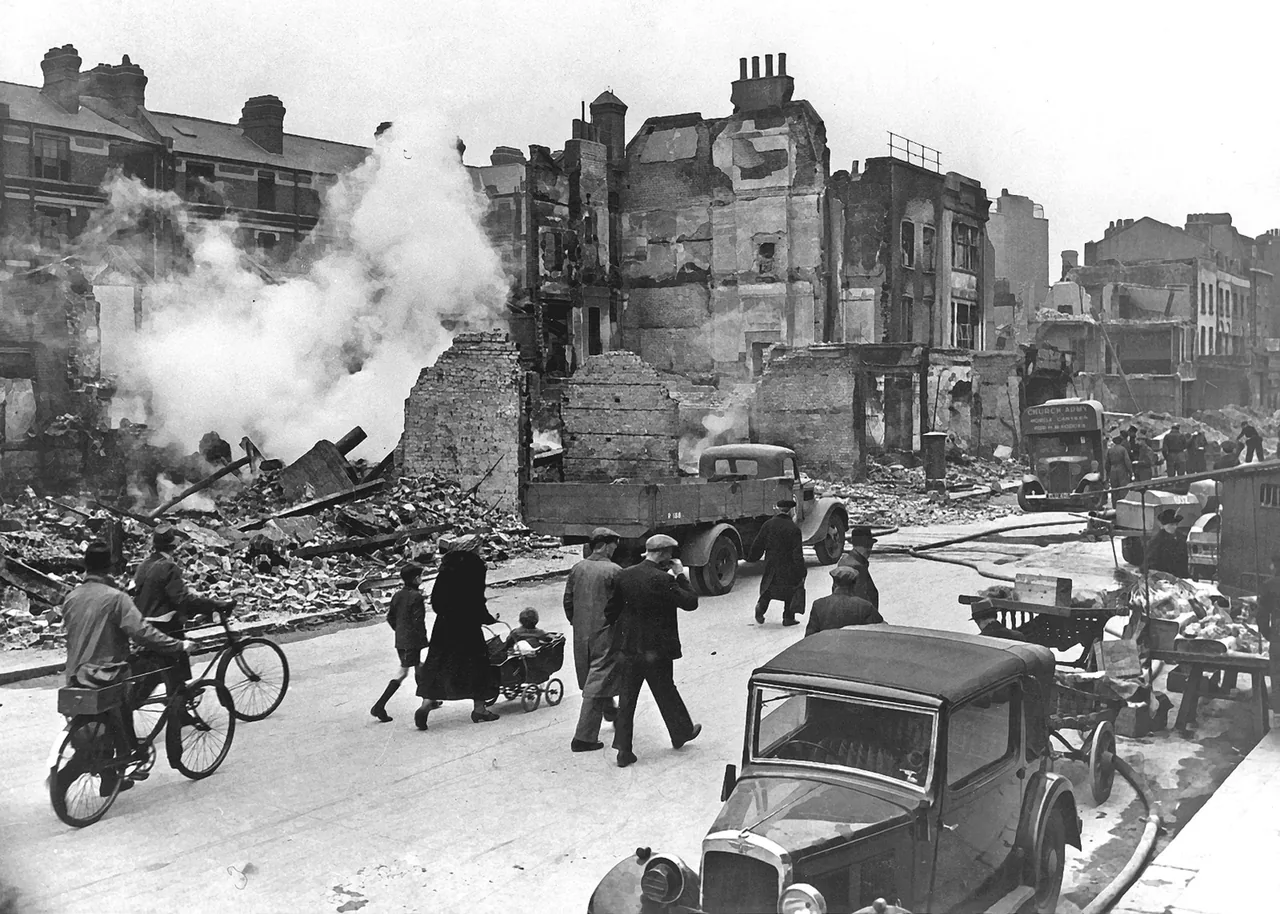
London stood at the intersection of two connected struggles: Britain’s defence against a planned German invasion and the survival of a city under sustained bombing. The Battle of Britain in 1940 prevented German air superiority; the Blitz then continued into May 1941.
Sources, licences and acknowledgements
U.S. Government · NARA 195566 · Original · Public domain (US government work)

Archival digital photograph resized and compressed without additional cropping.
Defending the skies
Summer–autumn 1940
Air superiority was a requirement for the planned invasion.
The Luftwaffe sought to defeat the Royal Air Force before a German invasion. Air bases and other military targets came under attack. Radar and ground observers helped defenders locate approaching raids and direct aircraft towards them.
Germany failed to gain the required air superiority and postponed the invasion. The Battle of Britain was not a battle fought over London alone: the wider air campaign extended across southeastern England.
The city becomes a sustained target
September 1940 – May 1941
Bombing changed how people worked, travelled and found shelter.
From 7 September 1940 London was repeatedly attacked; after October the Blitz became predominantly a night bombing campaign. Underground stations became communal shelters. The experience of trying to stay safe belonged alongside the work of pilots and air-defence personnel.
London was not the only target. Other ports and industrial cities also suffered attacks. Keeping that wider geography in view avoids turning Britain’s civilian war into the story of its capital alone.
Survival did not mean the war was over
1941
Britain continued fighting while the conflict spread.
Churchill’s government continued the war. Lend-Lease explains how American support developed while the United States was still outside the fighting. Meanwhile, in 1941, the war widened with the German invasion of the Soviet Union and Japan’s attack on Pearl Harbor.
The London reference point provides orientation within a wider area. It does not pinpoint an individual dogfight, bombing or the boundaries of the theatre.